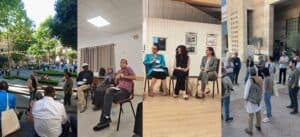
The workshop titled Rethinking Generalizable Knowledge: A View from Below, the product of a collaboration between the Shaharit Institute and the Van Leer Jerusalem Institute, was held in May 2025 with the participation of some 30 scholars and social activists from Israel and elsewhere. The participants, who share the ideas that the Challenge of Shared Life theme aims to promote, experienced together a three-day intellectual journey in the midst of Israeli society. By focusing on challenges of shared living and with the understanding that the existing theoretical knowledge about diversity does not address appropriately the many problems arising in the field, the workshop aimed to connect a local perspective and a global one, theory and practice, and the center and the periphery, whether geographic or ideological. The workshops tours focused on three test cases: the tensions between ultra-Orthodox Jews and other communities in Ashdod, the Price parade and the opposition to it in Jerusalem, and the struggle of the Bedouins in the village of Al-Furaa in the Negev for recognition and rights. In this way we were exposed to different patterns of shared life coming into existence from “below,” from the tensions, and in some cases even clashes, between sets of values and communities. A view of these patterns that is close to the local daily reality recognizes that sustainable solutions often come from life experiences and from the creative initiatives of the citizens themselves and not necessarily from those imposed on them from above or that are the outcome of outside and theoretical knowledge. Each of the stages on this path confronted us with fundamental questions regarding the limits of sharing and tolerance and recognition and representation, as well as the limits of knowledge—which so many cling to in academe and in civil society.
The shared premise in the discussions and activities in the workshop was that underlying the theoretical knowledge about shared life and diversity is a liberal grammar, that does not provide a complete and effective means of understanding and coping with the deep tensions that are leading to the increasing polarization in Israel and the world, and especially the tensions between liberal and other communities. The workshop aimed to broaden the interpretive lens and the political imagination. To that end it convened the varied and fascinating intercultural encounter of participants from five countries—Israel, Uganda, India, Serbia, and Great Britain—and between them and the actors in the various arenas. These encounters shed new light on fundamental questions that concern us in Israel, and they are relevant to the same degree also to the challenges of shared life of other societies in the world.