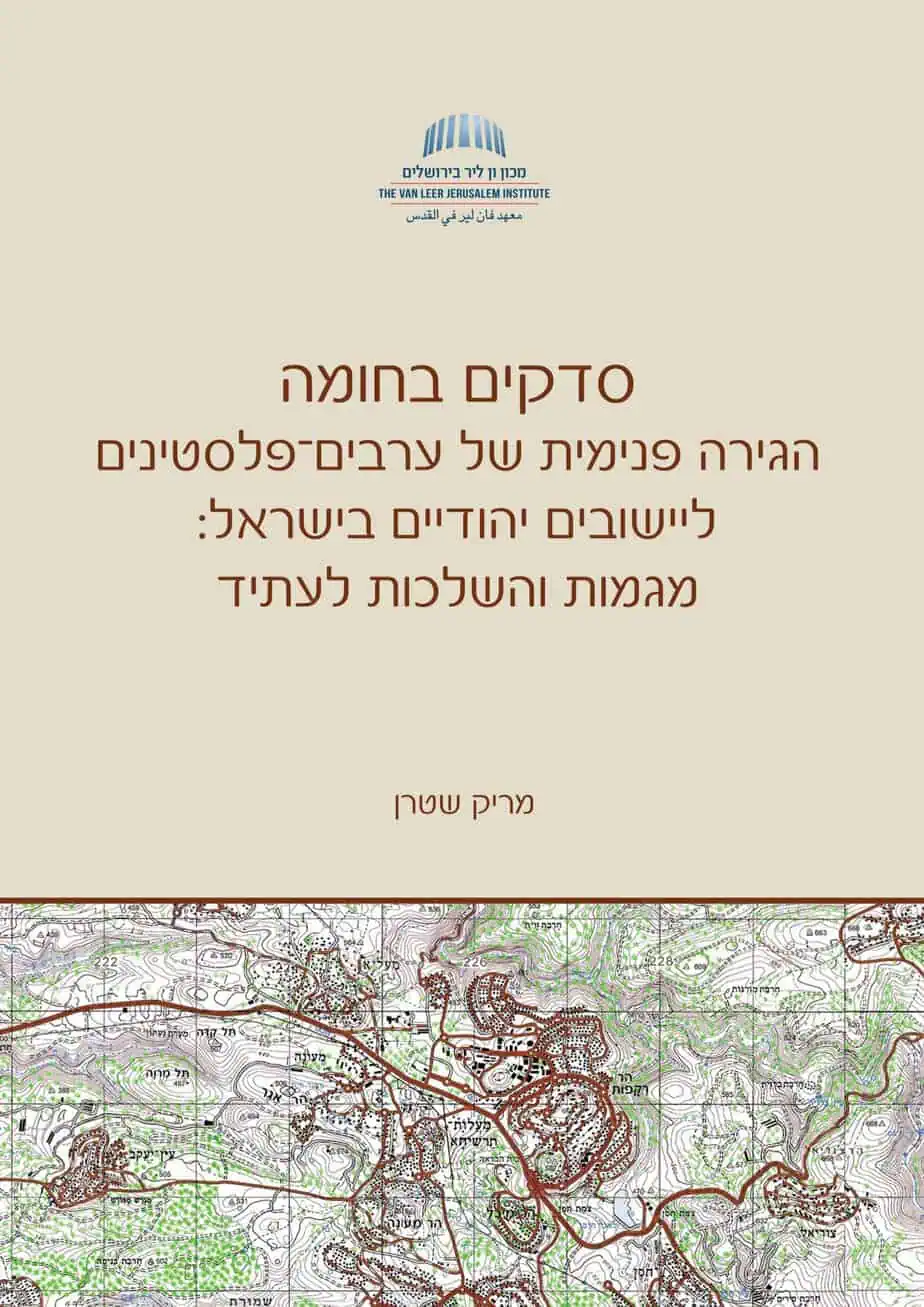
Cracks in the Wall
Palestinian Arab Internal Migration to Jewish Localities in Israel: Trends and Future Implications
Marik Shtern
This report analyzes patterns of internal migration among the Palestinian-Arab population in Israel between 2003 and 2023 and points to a consistent trend of migration to mixed cities and Jewish localities. This migration is driven by a combination of push factors, including housing shortages, underdevelopment, and declining personal security in Arab localities, and pull factors, such as the availability of housing, public services, and employment opportunities in Jewish localities—and is further associated with the expansion of the Arab middle class.
The findings show that the Arab population has grown in both officially mixed cities and Jewish localities that are not formally classified as mixed. In the latter, the Arab population increased by an exceptional 293 percent over two decades, compared with growth rates of approximately 58 percent in Arab localities and 70 percent in mixed cities. By 2023, dozens of Jewish localities had Arab populations of significant demographic weight, in some cases exceeding 5 percent of the local population. These figures indicate that numerous mixed localities are now taking shape across Israel.
The report frames this process as one of desegregation—a reduction in the spatial separation between Jews and Arabs that is not necessarily accompanied by social or political integration. Despite the expansion of everyday interactions between Jews and Arabs, the process is unfolding without sufficient institutional recognition. It is, at times, accompanied by resistance and increasingly exclusionary political discourse, particularly since the events of May 2021 and, even more so, since October 2023. At the same time, conditions are emerging that may foster shared communities and strengthen intercommunal resilience.
The report demonstrates that this is a nationwide phenomenon with far-reaching implications and that public policy and local actors will play a central role in shaping the future of Jewish-Arab relations in Israel. It concludes with a forward-looking assessment of possible developments should this process continue in the years ahead.