Worthy Curiosity
Dr. Adam Klin Oron | 07.07.2026 | Photo: Pixabay

When I was young, I was invited to a rather important interview. Naturally, I was quite nervous, so when asked, “What is the activity you most enjoy doing?” I found my verbal faculties have abandoned me and blurted out, “Knowledge.” The interviewer looked at me with an expression of impatient pity and said, not entirely gently, that knowledge is not an activity. I took a deep breath, glanced at the branches of the tree in the window behind her, its branches swaying in the wind (a wind that did not reach my sweaty forehead) and before I answered, I thought about it for a moment.
Knowledge is an activity, I told her — because the best way, or at least the most enjoyable way to learn is through conversation. The greatest pleasure, I continued, is to be able to sit with smart people and learn from them, or with them, through disagreement, debate, attempts at precision, and the search for common ground. This was before I was even familiar with the expression from Midrash Rabba, "a knife is sharpened only on the side of its counterpart, so, a Torah scholar is sharpened only by his counterpart," [or "A knife will only become sharpened only at the side of another. So too, a Torah scholar can only become sharpened by a friend."] but as it turns out, it was a concept that already deeply resonated with me.
Many years have passed since then. Today, there are a myriad of activities I enjoy very much that weren’t on my radar back then; spending time with my children, traveling abroad with my wife, teaching students, baking, working in a team. I have also since learned that I don’t like ranking things as “most.” How am I supposed to choose between C.S. Lewis and Faulkner, between tacos and ice cream, or between orange and purple? And yet, if I were once again placed in an intimidatingly stressful interview situation, there is a reasonable chance I would give the same answer — learning with others, alongside them and against them; the pursuit of knowledge that helps you understand existing concepts in a new light or reveals new concepts you didn’t even know existed. What could be better than that?
That’s my kind of fun. I respond to new knowledge with a little chuckle of happiness and a desire to share it with the world. Just ask my family how much I bombard them on the group chat every time I discover a new conspiracy theory about Tartaria, or what Nietzsche’s sister did in Paraguay. But beyond that, I believe that the best way to understand (always, but especially today) the complicated and unpredictable world we live in is through someone who has studied a certain field in depth, and, if possible, while that person is having a debate another person who has studied the same field but sees it differently. The knife does indeed become sharper, but more than that, the object being studied is better illuminated when it is examined from multiple angles.
We are lucky, then, to have Worthy Opponent.
For starters, it’s lucky because in Israel at any given time you can expect a fair share of arguments and discussions. Television and radio studios are full of them — it makes for good drama; it draws an audience and keeps production costs low… but most of them don’t teach you anything. More often than not, they feature a panel of people who essentially agree with one another and are simply arguing over the specific shade of their agreement, or, on the other hand, people whose disagreement is so deep that there is effectively no communication between them, and what viewers receive is only red-faced shouting. In both cases, the same speakers are often invited back regardless of the subject, leading to shallow and uninformed discussions. The only thing to be learned from these kinds of arguments (or agreements) is newfound anger, confirmation of things you already knew to be true, or verification that what you thought to be wrong, is in fact, wrong. New understandings that go beyond the echo chambers and confirmation biases from which we all suffer are few and far between.
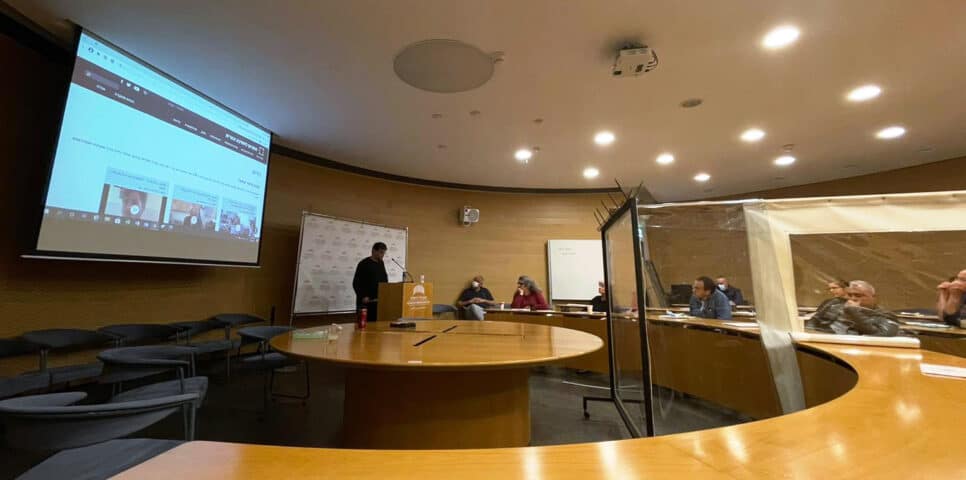
In Worthy Opponent, an initiative conceived by Lilach Karsenty, which I am proud to produce together with Tamar Winograd Amsalem, Daniel Jonas, and the team at 103FM, led by Michal Kadosh, we are trying to encourage a culture of disagreement, in both senses of the phrase — both disagreement, without hiding or blurring the differences, but also culture, one that allows for deeper engagement with the subject (as deep as one can go in half an hour) all conducted within a conversation based on mutual respect. After all, Israel is a country with a diversity of peoples and opinions. If we are to try and understand our opponents, but are unable to listen to one another without being obligated to agree, how are we supposed to live together?
But beyond that, it’s lucky that Worthy Opponent exists, because it has given me the opportunity to learn so many new things! In the first two seasons of the podcast we recorded 24 episodes on an enormous range of topics and questions: the integration of Haredim into Israeli society; whether Mizrahi Jews still suffer from discrimination; the use of artificial intelligence in medicine; whether there is a chance that Palestinian citizens of Israel will ever sit in the coalition; gender separation in academia; whether criticism of Israel is or is not antisemitic; Tel Aviv versus Jerusalem; and so much more.
And what did I learn? Here's a very partial list: that the reason there are secular people in Israel is because Martin Luther rebelled against the Catholic Church and founded Protestant Christianity (well, that I actually did happen to know); that there are about 45 different minority groups in Iran (that I really didn’t know); that the division into educational streams in the school system preceded the establishment of the State of Israel by more than twenty years; that in Israel, even if you did not marry through the Rabbinate, if you want to divorce, it will still have to happen through the Rabbinate; that these days, a serious attempt is being made to reestablish vocational education in Israel, but it is not certain that this can be done without creating oppression of certain populations; that the first youth trip to Poland took place in the 1960s, but that following the Six-Day War the trips were stopped and only resumed in 1983; and that today there are more than 130 religious settlement groups (Garin Torani) spread throughout the country. I also learned that the meaning behind all these facts is open to debate. For example, are the Torah-oriented settlement groups a heroic effort to assist disadvantaged populations, or are they another way for Ashkenazim to tell Mizrahim (not to mention Palestinians) how and where they are supposed to live?
I try to enter each studio recording without any bias on the topic of the episode. While this is, of course, not completely possible, I do come to learn, and I constantly overcome my urge to speak (or more like, preach). I listen closely to the argument, ask questions when I don’t understand, and try to decide who is right. It seems to me — and I would be happy to argue about this — that this is a position that ought to be more common in Israel. We live, as I mentioned, in a very diverse country and in a time when attention, patience, and tolerance for other opinions are steadily being worn down. But none of us are going anywhere. The Haredi, the secular, the Palestinian citizens of Israel and those who are not, religious Zionists, conservatives, feminists, the left, the right — we are all here. And not only that, any of those groups can be broken down into dozens of subgroups, opinions, ideologies, and lifestyles. Some say that we are stuck with one another, but I think that living in a homogeneous society is not only unrealistic, it’s also boring. Human existence is highly diverse, and while that can be complicated, it is also wonderful, surprising, and fascinating. It’s an opportunity to learn from one another, to get to know one another, and to use curiosity as a social tool in an attempt to draw closer — not in order to erase the differences, but to get to truly know them, and maybe even come to appreciate them.
After recording an episode, I sometimes discover that my previous opinion has in fact changed. And sometimes, my previous opinion is actually reinforced. But more than anything, I understand time and again, that there are multiple facets to every issue, that each side sincerely believes they are right, and that for the most part, each side also has good arguments that are worth knowing. More than anything — I get to learn.
And after all these years, there is still no greater pleasure than that.
Well, maybe my kids.
---
Dr. Adam Klin Oron is Head of Public Discourse and Director of the Digital Team at the Van Leer Jerusalem Institute; an anthropologist of religion and host of the Institute’s podcast Worthy Opponent, in partnership with 103FM.
All episodes of Worthy Opponent are available to listen to on Spotify. Episodes of the second and third season are also available to watch on YouTube.
For auto-generated English subtitles: Click the CC button on the YouTube video, then select Settings → Subtitles/CC → Auto-translate → English. On a phone or tablet, tap the video, open Settings, and select Captions → Auto-translate → English. Please note that automatically translated captions may not always be fully accurate.